Last week I attended the groundbreaking ceremony for the Lafitte Public Housing Projects. A few buildings from the old projects are to remain standing, but the rest have been or are about to be demolished and redeveloped into mixed income housing by Providence Community Housing, a non-profit developer. The ceremony was, from my outsiders perspective, bizarre--never have I seen such a mix of politics and Southern preachin'. To hear everybody talk (everybody being Mayor Nagin, Catholic Charities representatives, city council and congresspeople, former Lafitte residents, and even Obama-appointed HUD Secretary Shaun Donovan) God himself in all his Grace and Might descended from the heavens and operated the crane that tore those projects from the ground and pushed those shovels into the ground. He gave them strength, thank God--his Divine Judgement and Wisdom were behind the entire... thing.
"Thing" being either the Realization of the Kingdom or a gross Human Rights violation. Apparently neither God, nor the New Orleans Archdiocese, which has supported redevelopment, is on the side of the UN/Advisory Group on Forced Evictions, which has condemned the way New Orleans has handled the redevelopment of public housing since the storm, particularly the illegal forced evictions that occured with the backdrop of an unprecedented housing crises (anyone notice how Katrina kinda torn down a whole bunch of houses? anyone? it doesn't take a genius...).
Last night, I attended quite the opposite event--a film screening and informational session at the 7th Ward Neighborhood Center/the Porch. The film told the story of public housing residents who returned after the storm to find their homes boarded up (with expensive metal instead of boards), those who took back their units and cleaned them up only to be kicked out again, those who found their Section 8 vouchers to be absolutely useless, the suffering and the homeless. A nod was given to Obama and Donovan for the extension of vouchers issued specifically to hurricane victims, but otherwise most people present wanted the demolition to stop and there was the belief that the condition of the public housing was not bad at all--very little storm damage, perfectly livable--so the reason for demolition must be something evil, racist, classist, them vs. us.
Looking at these events, it seems like a clear-cut case of good vs. evil (although it is kind of messed up how God is invoked the most by the evil side... we can ignore that for now). But where is the grey area? The one that says, well New Orleans, you really did fuck up the process of redevelopement with your illegal evictions and lack of community input, but (BUT, there needs to be a BUT) redevelopment in and of itself is not all bad? There were former public housing residents on BOTH sides. I can't agree with either side completely, but I can't find a side in the middle--it's kind of frustrating.
The winning side, however, is pretty clear--as I've been told, New Orleans is great at throwing parties but not so great at building movements. To ask for a moratorium on demolition when most of it is already completed makes you a little bit late. There were no action items announced at the end of last night's event--red beans and rice and potatoe salad are delicious, but not the takeaways you want to provide if you're trying to drive people into action!
And on a side note, God should never be used to justify forcing people to patiently wait for what Man has actively and unjustly taken from them. Really I'm not sure God should be used to justify anything even remotely political (which, one could argue, includes just about everything), but especially not that.
28 August 2009

NHS and Human Rights?
I have one week left of my internship down here in New Orleans--my internship funded by the University of Chicago Human Rights Department. The who? The Human Rights Department. Does that mean I should maybe take some time to actually think about Human Rights while I'm here? Why yes, I believe it does!
There is no question that the work NHS does is human rights work--making homeownership more affordable and available, teaching useful financial skills to help people better manage their own money, working to prevent contractor fraud, giving space for community members to come together and grow and support initiatives that will improve their quality of life--but rights doctrine does not actually appear in its stated mission, goals, or values. Around the office I have heard people talk about wanting to help others, to make things better and to revitalize the community, but I have not heard these desires put into a human rights framework.
And yet it is Human Righst work. The UDHR states that: "Everyone has the right to a standard of living adequate for the health and well-being of himself and his family, including food, clothing, housing and medical care and necessary social services, and the right to security in the event of unemployment, sickness, disability, widowhood, old age or other lack of livelihood...." (Article 25). In the Covenant on Cultural, Social and Economic Rights, "The States Parties ... recognize the right of everyone to an adequate standard of living for himself and his family, including adequate food, clothing and housing, and to the continuous improvement of living conditions...." (Article 11). NHS works to make homeownership a viable housing option, thereby stabilizing communities and increasing the entire neighborhood's standard of living.
The UN-HABITAT agenda further commits the UN and partner nations to "the full and progressive realization of the right to adequate housing.... We recognize an obligation by Governments to enable people to obtain shelter and to protect and improve dwellings and neighbourhoods. We commit ourselves to the goal of improving living ... conditions on an equitable and sustainable basis, so that everyone will have adequate shelter that is healthy, safe, secure, accessible and affordable" (Habitat Agenda, paras 39 and 40). While what NHS does isn't about the "full and progressive realization" of housing rights, they do use government funds to protect and improve neighborhoods.
For even more international agreement on why housing is a human right, go here (the People's Movement for Human Rights Education) or check out the UN-HABITAT website ("Promoting sustainable urban development and adequate shelter for all").
The question I am asking myself now is whether NHS could do more to promote human rights by actively engaging in the human rights language and doctrines that it currently does not employ. Looked at through a lens of human rights, does the organization become more or less effective? Was I wrong to just accept that NHS is furthering human rights whether they know it or not and leave it at that, or should I have been more critical? Or was it good that I have practically ignored rights doctrine this summer, since sometimes it just gets in the way?
Rights doctrine is complicated--as a lens, it breaks down things into rights and non-rights and different kinds of rights and sometimes asks us to prioritize. This could be useful, but could also confuse us and lead us away from what we already know is just good, a positive, something the community needs to succeed whether its a right or not. When I told a coworker I was minoring in Human Rights, she remarked that it was kind of funny how human rights have become a profession now, instead of just something Human and Right for everybody.
The topic of Rights and NHS is something that I wish I had delved into earlier in the summer, but is maybe something I can think more about in my coursework next quarter.
There is no question that the work NHS does is human rights work--making homeownership more affordable and available, teaching useful financial skills to help people better manage their own money, working to prevent contractor fraud, giving space for community members to come together and grow and support initiatives that will improve their quality of life--but rights doctrine does not actually appear in its stated mission, goals, or values. Around the office I have heard people talk about wanting to help others, to make things better and to revitalize the community, but I have not heard these desires put into a human rights framework.
And yet it is Human Righst work. The UDHR states that: "Everyone has the right to a standard of living adequate for the health and well-being of himself and his family, including food, clothing, housing and medical care and necessary social services, and the right to security in the event of unemployment, sickness, disability, widowhood, old age or other lack of livelihood...." (Article 25). In the Covenant on Cultural, Social and Economic Rights, "The States Parties ... recognize the right of everyone to an adequate standard of living for himself and his family, including adequate food, clothing and housing, and to the continuous improvement of living conditions...." (Article 11). NHS works to make homeownership a viable housing option, thereby stabilizing communities and increasing the entire neighborhood's standard of living.
The UN-HABITAT agenda further commits the UN and partner nations to "the full and progressive realization of the right to adequate housing.... We recognize an obligation by Governments to enable people to obtain shelter and to protect and improve dwellings and neighbourhoods. We commit ourselves to the goal of improving living ... conditions on an equitable and sustainable basis, so that everyone will have adequate shelter that is healthy, safe, secure, accessible and affordable" (Habitat Agenda, paras 39 and 40). While what NHS does isn't about the "full and progressive realization" of housing rights, they do use government funds to protect and improve neighborhoods.
For even more international agreement on why housing is a human right, go here (the People's Movement for Human Rights Education) or check out the UN-HABITAT website ("Promoting sustainable urban development and adequate shelter for all").
The question I am asking myself now is whether NHS could do more to promote human rights by actively engaging in the human rights language and doctrines that it currently does not employ. Looked at through a lens of human rights, does the organization become more or less effective? Was I wrong to just accept that NHS is furthering human rights whether they know it or not and leave it at that, or should I have been more critical? Or was it good that I have practically ignored rights doctrine this summer, since sometimes it just gets in the way?
Rights doctrine is complicated--as a lens, it breaks down things into rights and non-rights and different kinds of rights and sometimes asks us to prioritize. This could be useful, but could also confuse us and lead us away from what we already know is just good, a positive, something the community needs to succeed whether its a right or not. When I told a coworker I was minoring in Human Rights, she remarked that it was kind of funny how human rights have become a profession now, instead of just something Human and Right for everybody.
The topic of Rights and NHS is something that I wish I had delved into earlier in the summer, but is maybe something I can think more about in my coursework next quarter.
27 August 2009
In the News: New Orleans + Obama = Seems OK
(Source: Truthout.org, http://www.truthout.org/082709S)
(Source: NYTimes, http://www.nytimes.com/2009/08/28/opinion/28liu.html?scp=1&sq=new%20orleans&st=cse)
Op-Chart
The State of New Orleans, An Update
Promises, Promises: Early Katrina Praise for Obama
Thursday 27 August 2009
by: Ben Evans And Becky Bohrer | Visit article original @ The Associated Press
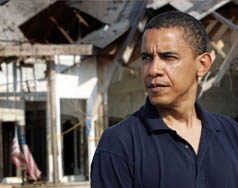
President Barack Obama tours the hurricane damaged streets of New Orleans. (Photo: BarackObama.com)
Washington - As a presidential candidate, Barack Obama pledged to right the wrongs he said bogged down efforts to rebuild the Gulf Coast after Hurricane Katrina. Seven months into the job, he's earning high praise from some unlikely places.
Gov. Bobby Jindal, R-La., says Obama's team has brought a more practical and flexible approach. Many local officials offer similar reviews. Even Doug O'Dell, former President George W. Bush's recovery coordinator, says the Obama administration's "new vision" appears to be turning things around.
Not too long ago, Jindal said in a telephone interview, Louisiana governors didn't have "very many positive things" to say about the Federal Emergency Management Agency.
But Jindal said he had a lot of respect for the current FEMA chief, Craig Fugate, and his team. "There is a sense of momentum and a desire to get things done," the governor said.
Added O'Dell: "I think the results are self-evident."
The retired Marine general served what he calls a frustrating stint as Bush's recovery coordinator last year. "What people have said to me is that for whatever reason, problems that were insurmountable under previous leadership are getting resolved quickly," O'Dell said.
"And I really hate to say that because (the top FEMA leaders) in my time there were good, hardworking, earnest men, but they were also the victims of their own bureaucracy."
It's not that Obama has miraculously mended the Gulf Coast since Katrina struck on Aug. 29, 2005. The storm killed more than 1,600 people in Louisiana and Mississippi and caused more than $40 billion in property damage. Hurricane Rita followed nearly a month later, with billions of dollars in additional damage and at least 11 more deaths.
On the fourth anniversary of Katrina, many communities remain broken, littered with boarded-up houses and overgrown vacant lots. Hundreds of projects - including critical needs such as sewer lines, fire stations and a hospital - are entangled in the bureaucracy or federal-local disputes over who should pick up the tab.
Like Bush, Obama has critics who say he's not moving aggressively enough.
Chris Kromm, director of the Institute for Southern Studies, an advocacy group, said the coast is "still waiting for Washington to show leadership."
In many areas, such as long-term coastal rehabilitation and rebuilding levees, it's too early to determine whether Obama will live up to the many promises he made.
But on several fronts, there is evidence of progress.
Victor Ukpolo, chancellor of Southern University at New Orleans, said the administration has been able to "move mountains" for his school, virtually wiped out by Katrina and the breached levees.
Homeland Security Secretary Janet Napolitano has visited the campus twice and awarded $32 million to replace four buildings.
"It's really awesome," Ukpolo said. "There's been so much progress."
Tommy Longo, mayor of Waveland, Miss., said it got so bad toward the end of Bush's tenure that "you almost couldn't get them to return a phone call, and you certainly weren't going to get them to make any big decisions."
"It has been refreshing to be back working with people who are hungry and want to make a difference," said Longo, a Democrat. "Who knows, a few years from now, at the end of Obama's term it may be back to the same ol', same ol', but it is refreshing now."
Obama backed up his pledge to name an experienced FEMA administrator by appointing Fugate, a career emergency management professional from Florida. By contrast, Bush's director was Michael Brown, a lawyer who worked at the International Arabian Horse Association. He resigned after Katrina.
In half a year, Obama's team says it has cleared at least 75 projects that were in dispute, including libraries, schools and university buildings. The administration has embraced a new, independent arbitration panel for the most stubborn disputes, and assigned senior advisers to focus on the rebuilding.
The administration recently reversed a FEMA rule that barred communities from building fire stations and other critical projects in vulnerable areas. Local officials said the rule could have effectively killed off some places.
The Bush administration's flat-footed response to Katrina left a lasting stain on Bush's legacy, and the sluggish pace of the long-term recovery has drawn continued criticism.
Local officials and civic leaders long have complained about the changing cast of FEMA representatives who review project worksheets and demand repeated inspections or additional paperwork. In some cases, agency workers have subtracted costs that local officials thought were settled.
Along with battling red tape, community officials say FEMA often stubbornly refused to pay for work that should have qualified for federal aid.
Under Bush, FEMA frequently argued that local governments viewed the storms as a chance to get rundown buildings replaced with federal dollars. Delays also were blamed on disarray at the local and state levels, with some projects stalled until local officials could decide their own priorities or provide documentation to make their case.
Critics countered that some Bush officials seemed more concerned with preventing fraud than getting people back on their feet.
Jindal and Paul Rainwater, the governor's recovery coordinator who once stormed out of a meeting with Bush officials in frustration, said plenty of headaches remain. Overall, Jindal gives the Obama administration an "incomplete" because there is so much still to do. A glaring example is the shuttered, 20-story Charity Hospital, which served New Orleans' poor and uninsured. The state claims it is owed nearly $500 million to replace it.
Despite high-level pleas, FEMA has denied the claim under both administrations, saying Charity wasn't properly guarded against further decay after the storm. The agency has offered $150 million, the most it says it can do. The Obama administration rejected a request to replace the hospital using economic stimulus money.
Jindal and Rainwater said the previous administration often wouldn't recognize new information or acknowledge there were real disputes. Sometimes, Rainwater said, Bush officials seemed blind to the devastation around them and said they had to be good stewards of public money.
"They never recognized the enormity of what we're working through," Rainwater said. "We're not just trying to rebuild buildings here but entire communities."
"That's the difference" under Obama, Rainwater said. "It's the recognition. ... We're all able to sit down around the table."
(Source: NYTimes, http://www.nytimes.com/2009/08/28/opinion/28liu.html?scp=1&sq=new%20orleans&st=cse)
The State of New Orleans, An Update
THIS year, the Gulf Coast’s recovery from Hurricane Katrina has become President Obama’s responsibility. How bad a situation has he inherited?
The good news is that, on the fourth anniversary of the storm, New Orleans is weathering the recession relatively well. Since June 2008, the metro area has shed only about one percent of its jobs, significantly less than the 4.1 percent of jobs that have been lost nationally. Over the past 12 months, unemployment in New Orleans has mostly hovered around 5 percent. It recently jumped to 7.3 percent, primarily because of an increase in the number of new job seekers (like recent college graduates), but that is still well below the national average of 9.5 percent. At a time when falling home values are keeping many Americans from moving, the city has attracted 10,000 new households, the biggest one-year expansion since 2007.
Continuing repairs to roads, bridges and public buildings in New Orleans are helping shield the area from a more serious slump. The region is also fortunate not to rely heavily on industries like manufacturing that are shedding jobs. And it has benefited from job growth in its sizable government sector, which handles many recovery-related contracts and activities.
Yet New Orleans is not impervious to the economic crisis. Its housing market has stalled, with 39 percent fewer people buying homes this year than did the year before, and 48 percent fewer new homes being built. Also, a drop in consumer spending has hurt city sales-tax revenues.
Meanwhile, New Orleans still has more than 62,000 blighted and vacant houses and apartment buildings. Rents have leveled off, but they remain 40 percent higher than they were before the storm. People worry about what kind of good, long-term jobs there will be to replace recovery-related jobs when those disappear.
In the past eight months, a number of Obama administration officials have visited New Orleans and Mississippi, and they have found ways to help — for example, by accelerating the pace of repairs and by finding homes for families still living in trailers. But next year’s five-year anniversary represents, for many, the midpoint in a 10-year recovery. President Obama’s biggest challenge is to work effectively with Louisiana officials and the next mayor of New Orleans to generate enough progress before next August to show that the city is truly reinventing itself, rather than simply returning to a suboptimal normal.
— AMY LIU, the deputy director of the metropolitan policy program at the Brookings Institution21 August 2009
GNOCDC Ten Minute Briefing on New Orleans' Recovery
This video from the Greater New Orleans Community Data Center moves a little too fast to really take in all the pretty graphs, but the graphs are pretty and it's overall very informative.
GNOCDC Ten Minute Briefing on New Orleans' Recovery
Shared via AddThis
GNOCDC Ten Minute Briefing on New Orleans' Recovery
Shared via AddThis
19 August 2009
T minus 2.5 Weeks
I think the reality that I only have 2.5 weeks left in New Orleans is starting to hit me. I feel like I just got here, but at the same time feel as if I've been here forever, if that makes any sense at all.
This has not been a summer of one singular accomplishment, but a whole bunch of little things mushed together into a very scattered experience. Property campaign letters and photos and merges, oh my! Endless SalesForce, Constant Contact and Excel spreadsheets. Prep for day camp and maybe another fair at the Freret Neighborhood Center. Outreach and phone calls at both centers. Circle Food 4 Thought phone calls and emails. Marketing stories to edit. And now I'm writing copy for... the entire NHS website? Or at least leaving it more organized than it's currently convoluted condition--there's so much content and so much debate about what that content should be and look like (ahhh office politics!) that I'm not sure I'll have time to finish.
I've done a lot, but it's kind of all over the place, so I don't have a very straightforward answer for the question of "What did you do last summer?" Everything!
Outside of work, I've also done a lot, and I feel like the experience of living down here has been just as valuable (if not more valuable) than what I've done at work. I've explored a new city, pretty much entirely alone--I have roommates, and while I did spend a little time trying to teach one of them to drive, I rarely see them. So I'll add adventuring into a bar alone, and shopping and entertaining myself alone, to my list of things I did this summer. I also got a lot more practice cooking for myself--it would have been awesome to eat out at all the delcious restaurants down here, every day, but cooking was friendlier on my wallet. I can't say I haven't ever been lonely (thank god for Firefly and The Office on Hulu! And books!), but I did end up meeting some great people. When they weren't around, I'm pretty great people, too, so it all worked out :)
I've also biked more than I ever have (thighs of steel!), and took yoga classes for the first time (love it!). Yesterday I ran 4 miles along the levee, the second 2 in the pouring rain, I might add--it kind of sucked, my headphones and/or iPod might be the price for not paying more attention to the weather. While I'm disappointed I couldn't get a gym or pool membership (that water is going to feel sooo good when I get home!), I've been pretty active. I'm also semi-tan, which is a first (for real! Lauren said so!).
So what about these next 2.5 weeks? The past 2 days have kind of sucked, actually--I can't seem to get back into working mode after Lauren and Katherine left on Tuesday morning, and getting stuck in a downpour 2 miles from my house, and then having a chuck of my living room ceiling collapse last night (the apartment is quite literally coming apart at the seams!), I haven't been in the best mood. But yoga tonight was restorative. I have a to-do list to work with and just enough time to do it (hopefully). Time to get cracking.
This has not been a summer of one singular accomplishment, but a whole bunch of little things mushed together into a very scattered experience. Property campaign letters and photos and merges, oh my! Endless SalesForce, Constant Contact and Excel spreadsheets. Prep for day camp and maybe another fair at the Freret Neighborhood Center. Outreach and phone calls at both centers. Circle Food 4 Thought phone calls and emails. Marketing stories to edit. And now I'm writing copy for... the entire NHS website? Or at least leaving it more organized than it's currently convoluted condition--there's so much content and so much debate about what that content should be and look like (ahhh office politics!) that I'm not sure I'll have time to finish.
I've done a lot, but it's kind of all over the place, so I don't have a very straightforward answer for the question of "What did you do last summer?" Everything!
Outside of work, I've also done a lot, and I feel like the experience of living down here has been just as valuable (if not more valuable) than what I've done at work. I've explored a new city, pretty much entirely alone--I have roommates, and while I did spend a little time trying to teach one of them to drive, I rarely see them. So I'll add adventuring into a bar alone, and shopping and entertaining myself alone, to my list of things I did this summer. I also got a lot more practice cooking for myself--it would have been awesome to eat out at all the delcious restaurants down here, every day, but cooking was friendlier on my wallet. I can't say I haven't ever been lonely (thank god for Firefly and The Office on Hulu! And books!), but I did end up meeting some great people. When they weren't around, I'm pretty great people, too, so it all worked out :)
I've also biked more than I ever have (thighs of steel!), and took yoga classes for the first time (love it!). Yesterday I ran 4 miles along the levee, the second 2 in the pouring rain, I might add--it kind of sucked, my headphones and/or iPod might be the price for not paying more attention to the weather. While I'm disappointed I couldn't get a gym or pool membership (that water is going to feel sooo good when I get home!), I've been pretty active. I'm also semi-tan, which is a first (for real! Lauren said so!).
So what about these next 2.5 weeks? The past 2 days have kind of sucked, actually--I can't seem to get back into working mode after Lauren and Katherine left on Tuesday morning, and getting stuck in a downpour 2 miles from my house, and then having a chuck of my living room ceiling collapse last night (the apartment is quite literally coming apart at the seams!), I haven't been in the best mood. But yoga tonight was restorative. I have a to-do list to work with and just enough time to do it (hopefully). Time to get cracking.
12 August 2009
Eat + Dance + Sing + Paint = Activate!
Ah! A lot has happened, sorry I haven't really been keeping up with my blog. Last week was the Night Out Against Crime and the Circle Food 4 Thought Campaign Kick-off, both of which went really well, and then my parents and brother Tommy came to visit for the weekend. This all left me thoroughly stuffed with action and really good food!
For Circle Food 4 Thought photos (and all the others I've taken down here) go to:
http://www.facebook.com/album.php?aid=2100092&id=2911230&l=2a6271d825
Night Out Against Crime (Tuesday, August 4th) is a national day to support community solidarity in the face of criminal activity in their neighborhood, so there were block parties happening all over the city/country. I went to one sponsored by Neighbors United a few blocks from the NHS Main Office, where I helped the Freret Neighborhood Center pass out free backpacks full of school supplies that were donated by the Salvation Army. And here is where my week of awesome food began: I had grillades and grits, which was really delicious.
The very next day (Wednesday, August 5th) was the Circle Food 4 Thought Kick-off Event. I spent the hours before the event started helping to hurridly put labels on 2,500 postcards so that people could sign one for each of 3 City Council representatives asking for the city's support in reopening Circle Food Store. Printing and sticking address labels is tedious work, as was much of the work I did in the weeks prior (calling people to invite them to a task force meeting, calling them again to tell them it was cancelled, calling a bunch more people to invite them to the event, researching press-release opportunities...), but when everything came together, the resulting event went really well. 350+ people attended, there was motivational speaking, postcard signing, a brass band, dancing, and of course, fresh local foods! My parents arrived just as the event was ending, in time to get some really delicious shrimp, watermelon, snoballs and lemonade.
Thursday morning, I met with David and Linda about a newer project of mine--NHS is in the process of revamping their website, and while they have hired a company to help with this, they still need to write their own copy. Or should I say, they still need to have an intern write their copy? I've started out by editing a bunch of marketing stories they've collected and highlighting areas that could use more information--these can go both on the website and in other publications. I will also be collecting/writing more stories, since so far they don't have any about success they've had with the neighborhood centers. The website also needs descriptions of NHS services, what each department does, information on how to buy/renovate a home, etc, which I will be working with the appropriate staff people to write.
Thursday afternoon and Friday I took off to spend time with my family--by the time they left on Tuesday, we had eaten po-boys, walked around the French Quarter and French Market, eaten beignet at Cafe Dumonde, taken a ghost tour and a swamp tour, eaten gumbo and seafood, and visted the Audobon Zoo. My dad and I also spent Saturday in Gentilly working on a house with the Episcopal Disaster Recovery organization, and later that day met up with my mom and Tommy to attend a performance by the Urban Bush Women leadership conference that's been going on this week (sponsored by NHS/7th Ward Neighborhood Center). It was kind of crazy, but overall a pretty awesome time.
Now I'm back at work following up with the campaign kick-off by sorting all the postcards that were signed and entering all the new contact information we got from sign-in sheets into an excel document, and then into our gmail account so that we can invite people to the next task force meeting for the campaign. And of course, not everyone has email, so I will probably have to call all the people who said they were interested but didn't give an email address.
For relaxation, tonight there is a free yoga class at the Freret Neighborhood Center!
For Circle Food 4 Thought photos (and all the others I've taken down here) go to:
http://www.facebook.com/album.php?aid=2100092&id=2911230&l=2a6271d825
Night Out Against Crime (Tuesday, August 4th) is a national day to support community solidarity in the face of criminal activity in their neighborhood, so there were block parties happening all over the city/country. I went to one sponsored by Neighbors United a few blocks from the NHS Main Office, where I helped the Freret Neighborhood Center pass out free backpacks full of school supplies that were donated by the Salvation Army. And here is where my week of awesome food began: I had grillades and grits, which was really delicious.
The very next day (Wednesday, August 5th) was the Circle Food 4 Thought Kick-off Event. I spent the hours before the event started helping to hurridly put labels on 2,500 postcards so that people could sign one for each of 3 City Council representatives asking for the city's support in reopening Circle Food Store. Printing and sticking address labels is tedious work, as was much of the work I did in the weeks prior (calling people to invite them to a task force meeting, calling them again to tell them it was cancelled, calling a bunch more people to invite them to the event, researching press-release opportunities...), but when everything came together, the resulting event went really well. 350+ people attended, there was motivational speaking, postcard signing, a brass band, dancing, and of course, fresh local foods! My parents arrived just as the event was ending, in time to get some really delicious shrimp, watermelon, snoballs and lemonade.
Thursday morning, I met with David and Linda about a newer project of mine--NHS is in the process of revamping their website, and while they have hired a company to help with this, they still need to write their own copy. Or should I say, they still need to have an intern write their copy? I've started out by editing a bunch of marketing stories they've collected and highlighting areas that could use more information--these can go both on the website and in other publications. I will also be collecting/writing more stories, since so far they don't have any about success they've had with the neighborhood centers. The website also needs descriptions of NHS services, what each department does, information on how to buy/renovate a home, etc, which I will be working with the appropriate staff people to write.
Thursday afternoon and Friday I took off to spend time with my family--by the time they left on Tuesday, we had eaten po-boys, walked around the French Quarter and French Market, eaten beignet at Cafe Dumonde, taken a ghost tour and a swamp tour, eaten gumbo and seafood, and visted the Audobon Zoo. My dad and I also spent Saturday in Gentilly working on a house with the Episcopal Disaster Recovery organization, and later that day met up with my mom and Tommy to attend a performance by the Urban Bush Women leadership conference that's been going on this week (sponsored by NHS/7th Ward Neighborhood Center). It was kind of crazy, but overall a pretty awesome time.
Now I'm back at work following up with the campaign kick-off by sorting all the postcards that were signed and entering all the new contact information we got from sign-in sheets into an excel document, and then into our gmail account so that we can invite people to the next task force meeting for the campaign. And of course, not everyone has email, so I will probably have to call all the people who said they were interested but didn't give an email address.
For relaxation, tonight there is a free yoga class at the Freret Neighborhood Center!
04 August 2009
A great opinion article on the storm from t r u t h o u t
This article is very good, although quite depressing. One of the comments posted counters the gloom quite nicely: "[New Orleans] is far from dead, it is alive with young people streaming in from all over the U.S. to party and make families and dedicate themselves to restoring the city. It is not dead, it is alive with people who live with passion and joy and appreciation of all the shabby/elegant beauty and music and FOOD that the city offers."
Do You Know What It Means to Miss New Orleans?
Monday 03 August 2009
by: William Rivers Pitt, t r u t h o u t | Columnist
New Orleans resident Robert Green Sr. stands where his mother's home once stood in the lower ninth ward. Green's mother died during the Hurricane. (Photo: Ted Jackson / The Times - Picayune)
Do you know what it means to miss New Orleans,
And miss it each night and day?
I know I'm not wrong, the feeling's getting stronger,
The longer I stay away ...
- Louis Armstrong
The city of New Orleans will be on the minds of many in the coming days and weeks. The four-year anniversary of the worst civil catastrophe in American history - one of the worst such catastrophes in all of human history - will soon be upon us. It was four years ago, the length of one presidential term, that a storm came, and the seas rose, and the levees fell and a city was, for all practical purposes, murdered right before our eyes.
Four years ago, it happened like this.
On August 23, 2005, Tropical Depression Twelve swallowed up the remains of Tropical Depression Ten over the Bahamas and Puerto Rico and began moving towards the United States. Two days later, the storm was designated a hurricane and named Katrina. It made landfall in Florida and swung to the south-southwest, gathering strength from the warm waters of the Gulf of Mexico. A day later, the storm's track was recalibrated by the National Hurricane Center, with the line pointing straight into the heart of the Mississippi Delta. Louisiana Gov. Kathleen Blanco declared a state of emergency, and the Louisiana National Guard was mobilized.
By dawn the next day, Katrina had become a Category 3 hurricane. Evacuations, at first voluntary and later mandatory, were ordered in the parishes that lay across the path of the storm. New Orleans Mayor Ray Nagin emphasized to residents of the Ninth Ward to get a head start on the evacuation. Ten truckloads of water and meals were delivered to the Superdome, enough to support 15,000 refugees for three days. That night, George W. Bush was briefed by National Hurricane Center Director Max Mayfield on the status of and potential danger posed by Katrina. Forty minutes after midnight, Katrina became a Category 4 hurricane.
By 7:00 AM (CDT), Katrina had become a Category 5 hurricane, with maximum sustained winds of 175 mph and gusts up to 215 mph. The storm was expected to make landfall overnight, and New Orleans lay directly in its path. Mayor Nagin ordered the mandatory evacuation of the city, and close to 30,000 people poured into the Superdome seeking shelter. George W. Bush participated in a video conference with Max Mayfield and FEMA Director Michael Brown, who warned Mr. Bush that the storm was more severe than Andrew, was headed directly for New Orleans and the city's levees were in grave danger of collapse. Brown emphatically described Katrina as "the big one." Mr. Bush said exactly 40 words - one sentence promising support - and stayed mute for the rest of the meeting.
That was Sunday, August 28, 2005, the last day the city of New Orleans would exist as we have known it. At 6:10 AM (CDT) the next day, Katrina made landfall in Louisiana.
By the end of that Monday, virtually the entire city of New Orleans was under more than ten feet of water. Rooftops began to disappear under the incoming tide. Levee after levee failed, an event later blamed on the Louisiana Army Corps of Engineers, despite the fact that George W. Bush that same year had stripped more than $70 million in funding for the maintenance of those levees - virtually the entire Louisiana COE budget - to pay for his ongoing wars in Iraq and Afghanistan.
Like a slow-motion nightmare, Americans watched the steady annihilation of New Orleans unfold on television while Bush discussed immigration with Homeland Security Director Michael Chertoff, shared a birthday cake photo-op with Sen. John McCain, promoted his Medicare Drug Benefit plan in Arizona and California and went to bed without responding to Governor Blanco's urgent plea for assistance. "Mr. President, we need your help," read the message she had relayed to Bush that day. "We need everything you've got." There would be no reply that day.
It was not until the middle of the next day that Director Chertoff became aware that the New Orleans levees had failed and that the city was in mortal peril. Mr. Bush played guitar on television with country star Mark Willis next to split-screen images of bodies floating in the floodwaters and scenes of residents "looting" stores, much of which was perpetrated by stranded citizens seeking food and shelter. It had been three days since tens of thousands of people had sought shelter in the Superdome, food and water were running out, sanitary conditions were execrable, the heat became overwhelming and people started dying like insects stuffed in a killing bottle by a cruel, sadistic child. Residents trying to flee across the bridge were turned back at gunpoint. The city of New Orleans finally collapsed into chaos and drowned in salt water on national television.
A city still stands where New Orleans once was, and bears the same name, but it is not the same city, and never will be again. The death toll will never be known, because the river and the swamp and the sea took so many and kept them, because those who were lost were mostly the unnumbered poor who lacked the means to flee, because back in those days, we didn't do body counts. Thousands upon thousands of the city's residents are still gone four years later, either to the grave or to far-flung points on the compass, evacuees with no way to return home and, in many cases, no homes to return to. Most of the Ninth Ward still remains a sculpture of rubble and destruction to this day.
What does it mean to miss New Orleans? It means knowing that one of the most golden citadels of our shared history - a cradle of multiculturalism, the birthplace of jazz, seed corn of so much that is America - was allowed to die of neglect, disdain, racism, greed and simple stupidity right before our eyes. A city stands where New Orleans once was, but it is not New Orleans, not really. All that was the city, all that it gave this country, and so many of the people who lived there, are gone forever.
Do not forget, do not let your children forget, what it means to miss New Orleans.
William Rivers Pitt is a New York Times and internationally bestselling author of two books: "War on Iraq: What Team Bush Doesn't Want You to Know" and "The Greatest Sedition Is Silence." His newest book, "House of Ill Repute: Reflections on War, Lies, and America's Ravaged Reputation," is now available from PoliPointPress.
The Good, The Bad, The Peace Corps
Things have been kind of crazy! We'll do the annoying things first:
Annoying:
1) Saturday, it rained in my bathroom. Almost literally--I had to hold an umbrella above my head to pee. Of course, the only part that wasn't leaking was right above the bath tub, nobody was home in the unit upstairs, and the landlord took forever to get there. The water running down the wall with the window was so bad that it was pouring out the window onto the ground outside--a neighbor stopped by to inform us of this. He was going to help us break down the door upstairs if the landlord hadn't finally shown up. They fixed the pipe to the toilet tank (which was broken apparently?) but didn't even come look at our bathroom, which still smells pretty badly of mold/mildew, especially where it leaked behind a very improperly installed shower surround.
2) Sunday, my roommates and I planned to go out to lunch and then shopping, but her car wouldn't start. She called AAA and they replaced her battery--apparently it was the wrong kind?
3) Yesterday I left work a little early to try to beat the rain, and failed. I got stuck biking in a downpour and couldn't see anything, so I had to stop and stand underneath a random little awning until it stopped. When the sun finally came out, it... started raining even harder!! This lead me to conclude that the sky in New Orleans is, in fact, broken.
Ok. Enough bitching. My weekend was still awesome because:
1) I finally made it over to Frenchmen Street on Friday and saw Good Enough for Good Times (awesome awesome brass band) at d.b.a. It was a really great time, I'm very glad I went.
2) Saturday I went downtown for Satchmo Summerfest--my first New Orleans festival! I ate shrimp remoulade, a crawfish egg roll (New Orleans meets Vietnamese?) and a chocolate hazelnut crepe, all of which were really delicious. And I got to watch the kids from the Freret Neighborhood Center day camp perform their Second Line dance, which was super adorable.
3) That same night, while we apparently missed the White Linen Party, I tried oysters for the first time--it was definitely a day for interesting sea food--and then we wandered around Bourbon Street, which, while kind of insane/excessive, was still a good time.
4) I found out today that I was nominated for the PEACE CORPS!! Water and Sanitation Program in Central/South America or the Caribbean, starting in August 2010! Now I just need to fill out all kinds of medical forms before I can actually be invited for a placement... but still! w00t w00t!!
Tonight is the Night Out Against Crime and tomorrow is the kickoff for Circle Food 4 Thought (the campaign to reopen Circle Food store in the 7th Ward). This post doesn't say a ton about work, but all this community action also makes me really happy to be here--the work comes down to a lot of making phone calls and handing out fliers (re: not that interesting) but I'm exciting to see how things play out.
Annoying:
1) Saturday, it rained in my bathroom. Almost literally--I had to hold an umbrella above my head to pee. Of course, the only part that wasn't leaking was right above the bath tub, nobody was home in the unit upstairs, and the landlord took forever to get there. The water running down the wall with the window was so bad that it was pouring out the window onto the ground outside--a neighbor stopped by to inform us of this. He was going to help us break down the door upstairs if the landlord hadn't finally shown up. They fixed the pipe to the toilet tank (which was broken apparently?) but didn't even come look at our bathroom, which still smells pretty badly of mold/mildew, especially where it leaked behind a very improperly installed shower surround.
2) Sunday, my roommates and I planned to go out to lunch and then shopping, but her car wouldn't start. She called AAA and they replaced her battery--apparently it was the wrong kind?
3) Yesterday I left work a little early to try to beat the rain, and failed. I got stuck biking in a downpour and couldn't see anything, so I had to stop and stand underneath a random little awning until it stopped. When the sun finally came out, it... started raining even harder!! This lead me to conclude that the sky in New Orleans is, in fact, broken.
Ok. Enough bitching. My weekend was still awesome because:
1) I finally made it over to Frenchmen Street on Friday and saw Good Enough for Good Times (awesome awesome brass band) at d.b.a. It was a really great time, I'm very glad I went.
2) Saturday I went downtown for Satchmo Summerfest--my first New Orleans festival! I ate shrimp remoulade, a crawfish egg roll (New Orleans meets Vietnamese?) and a chocolate hazelnut crepe, all of which were really delicious. And I got to watch the kids from the Freret Neighborhood Center day camp perform their Second Line dance, which was super adorable.
3) That same night, while we apparently missed the White Linen Party, I tried oysters for the first time--it was definitely a day for interesting sea food--and then we wandered around Bourbon Street, which, while kind of insane/excessive, was still a good time.
4) I found out today that I was nominated for the PEACE CORPS!! Water and Sanitation Program in Central/South America or the Caribbean, starting in August 2010! Now I just need to fill out all kinds of medical forms before I can actually be invited for a placement... but still! w00t w00t!!
Tonight is the Night Out Against Crime and tomorrow is the kickoff for Circle Food 4 Thought (the campaign to reopen Circle Food store in the 7th Ward). This post doesn't say a ton about work, but all this community action also makes me really happy to be here--the work comes down to a lot of making phone calls and handing out fliers (re: not that interesting) but I'm exciting to see how things play out.
Subscribe to:
Posts (Atom)