Promises, Promises: Early Katrina Praise for Obama
Thursday 27 August 2009
by: Ben Evans And Becky Bohrer | Visit article original @ The Associated Press
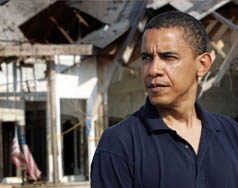
President Barack Obama tours the hurricane damaged streets of New Orleans. (Photo: BarackObama.com)
Washington - As a presidential candidate, Barack Obama pledged to right the wrongs he said bogged down efforts to rebuild the Gulf Coast after Hurricane Katrina. Seven months into the job, he's earning high praise from some unlikely places.
Gov. Bobby Jindal, R-La., says Obama's team has brought a more practical and flexible approach. Many local officials offer similar reviews. Even Doug O'Dell, former President George W. Bush's recovery coordinator, says the Obama administration's "new vision" appears to be turning things around.
Not too long ago, Jindal said in a telephone interview, Louisiana governors didn't have "very many positive things" to say about the Federal Emergency Management Agency.
But Jindal said he had a lot of respect for the current FEMA chief, Craig Fugate, and his team. "There is a sense of momentum and a desire to get things done," the governor said.
Added O'Dell: "I think the results are self-evident."
The retired Marine general served what he calls a frustrating stint as Bush's recovery coordinator last year. "What people have said to me is that for whatever reason, problems that were insurmountable under previous leadership are getting resolved quickly," O'Dell said.
"And I really hate to say that because (the top FEMA leaders) in my time there were good, hardworking, earnest men, but they were also the victims of their own bureaucracy."
It's not that Obama has miraculously mended the Gulf Coast since Katrina struck on Aug. 29, 2005. The storm killed more than 1,600 people in Louisiana and Mississippi and caused more than $40 billion in property damage. Hurricane Rita followed nearly a month later, with billions of dollars in additional damage and at least 11 more deaths.
On the fourth anniversary of Katrina, many communities remain broken, littered with boarded-up houses and overgrown vacant lots. Hundreds of projects - including critical needs such as sewer lines, fire stations and a hospital - are entangled in the bureaucracy or federal-local disputes over who should pick up the tab.
Like Bush, Obama has critics who say he's not moving aggressively enough.
Chris Kromm, director of the Institute for Southern Studies, an advocacy group, said the coast is "still waiting for Washington to show leadership."
In many areas, such as long-term coastal rehabilitation and rebuilding levees, it's too early to determine whether Obama will live up to the many promises he made.
But on several fronts, there is evidence of progress.
Victor Ukpolo, chancellor of Southern University at New Orleans, said the administration has been able to "move mountains" for his school, virtually wiped out by Katrina and the breached levees.
Homeland Security Secretary Janet Napolitano has visited the campus twice and awarded $32 million to replace four buildings.
"It's really awesome," Ukpolo said. "There's been so much progress."
Tommy Longo, mayor of Waveland, Miss., said it got so bad toward the end of Bush's tenure that "you almost couldn't get them to return a phone call, and you certainly weren't going to get them to make any big decisions."
"It has been refreshing to be back working with people who are hungry and want to make a difference," said Longo, a Democrat. "Who knows, a few years from now, at the end of Obama's term it may be back to the same ol', same ol', but it is refreshing now."
Obama backed up his pledge to name an experienced FEMA administrator by appointing Fugate, a career emergency management professional from Florida. By contrast, Bush's director was Michael Brown, a lawyer who worked at the International Arabian Horse Association. He resigned after Katrina.
In half a year, Obama's team says it has cleared at least 75 projects that were in dispute, including libraries, schools and university buildings. The administration has embraced a new, independent arbitration panel for the most stubborn disputes, and assigned senior advisers to focus on the rebuilding.
The administration recently reversed a FEMA rule that barred communities from building fire stations and other critical projects in vulnerable areas. Local officials said the rule could have effectively killed off some places.
The Bush administration's flat-footed response to Katrina left a lasting stain on Bush's legacy, and the sluggish pace of the long-term recovery has drawn continued criticism.
Local officials and civic leaders long have complained about the changing cast of FEMA representatives who review project worksheets and demand repeated inspections or additional paperwork. In some cases, agency workers have subtracted costs that local officials thought were settled.
Along with battling red tape, community officials say FEMA often stubbornly refused to pay for work that should have qualified for federal aid.
Under Bush, FEMA frequently argued that local governments viewed the storms as a chance to get rundown buildings replaced with federal dollars. Delays also were blamed on disarray at the local and state levels, with some projects stalled until local officials could decide their own priorities or provide documentation to make their case.
Critics countered that some Bush officials seemed more concerned with preventing fraud than getting people back on their feet.
Jindal and Paul Rainwater, the governor's recovery coordinator who once stormed out of a meeting with Bush officials in frustration, said plenty of headaches remain. Overall, Jindal gives the Obama administration an "incomplete" because there is so much still to do. A glaring example is the shuttered, 20-story Charity Hospital, which served New Orleans' poor and uninsured. The state claims it is owed nearly $500 million to replace it.
Despite high-level pleas, FEMA has denied the claim under both administrations, saying Charity wasn't properly guarded against further decay after the storm. The agency has offered $150 million, the most it says it can do. The Obama administration rejected a request to replace the hospital using economic stimulus money.
Jindal and Rainwater said the previous administration often wouldn't recognize new information or acknowledge there were real disputes. Sometimes, Rainwater said, Bush officials seemed blind to the devastation around them and said they had to be good stewards of public money.
"They never recognized the enormity of what we're working through," Rainwater said. "We're not just trying to rebuild buildings here but entire communities."
"That's the difference" under Obama, Rainwater said. "It's the recognition. ... We're all able to sit down around the table."
(Source: NYTimes, http://www.nytimes.com/2009/08/28/opinion/28liu.html?scp=1&sq=new%20orleans&st=cse)
The State of New Orleans, An Update
THIS year, the Gulf Coast’s recovery from Hurricane Katrina has become President Obama’s responsibility. How bad a situation has he inherited?
The good news is that, on the fourth anniversary of the storm, New Orleans is weathering the recession relatively well. Since June 2008, the metro area has shed only about one percent of its jobs, significantly less than the 4.1 percent of jobs that have been lost nationally. Over the past 12 months, unemployment in New Orleans has mostly hovered around 5 percent. It recently jumped to 7.3 percent, primarily because of an increase in the number of new job seekers (like recent college graduates), but that is still well below the national average of 9.5 percent. At a time when falling home values are keeping many Americans from moving, the city has attracted 10,000 new households, the biggest one-year expansion since 2007.
Continuing repairs to roads, bridges and public buildings in New Orleans are helping shield the area from a more serious slump. The region is also fortunate not to rely heavily on industries like manufacturing that are shedding jobs. And it has benefited from job growth in its sizable government sector, which handles many recovery-related contracts and activities.
Yet New Orleans is not impervious to the economic crisis. Its housing market has stalled, with 39 percent fewer people buying homes this year than did the year before, and 48 percent fewer new homes being built. Also, a drop in consumer spending has hurt city sales-tax revenues.
Meanwhile, New Orleans still has more than 62,000 blighted and vacant houses and apartment buildings. Rents have leveled off, but they remain 40 percent higher than they were before the storm. People worry about what kind of good, long-term jobs there will be to replace recovery-related jobs when those disappear.
In the past eight months, a number of Obama administration officials have visited New Orleans and Mississippi, and they have found ways to help — for example, by accelerating the pace of repairs and by finding homes for families still living in trailers. But next year’s five-year anniversary represents, for many, the midpoint in a 10-year recovery. President Obama’s biggest challenge is to work effectively with Louisiana officials and the next mayor of New Orleans to generate enough progress before next August to show that the city is truly reinventing itself, rather than simply returning to a suboptimal normal.
— AMY LIU, the deputy director of the metropolitan policy program at the Brookings Institution
No comments:
Post a Comment